Meta Testimonial Ads Deconstructed (With Examples)
A testimonial ad on Meta has one job: let an existing customer handle objections for you. The reader should think: that's me, and that's my worry, answered.

Radi Huq · Co-Founder of StaticAds.ai
· 8 min read
What is a testimonial ad on Meta?
A testimonial ad on Meta has one job: let an existing customer handle objections for you.
Testimonial ads speak to a Product Aware audience. These people know your brand and maybe your product. They haven't decided it's right for them, or worth the price. They don't need more claims. They need proof from someone like them.
In our swipe file, 35 of the 36 testimonial ads are aimed at a Product Aware audience.
What does Product Aware mean?
Product Aware is one of five stages of awareness from Eugene Schwartz's Breakthrough Advertising (1966). Each stage describes what the reader already knows:
- Unaware: they don't know they have the problem.
- Problem Aware: they know the problem, but not the solutions.
- Solution Aware: they know solutions exist, but not your product.
- Product Aware: they know your product, but haven't decided it's right for them. This is where testimonial ads work.
- Most Aware: they know your product and want it. They need a reason to buy now, which is the job of an offer ad.
Why does a customer's word work better than yours?
When a brand says it, it's a claim. When a customer says it, it's proof.
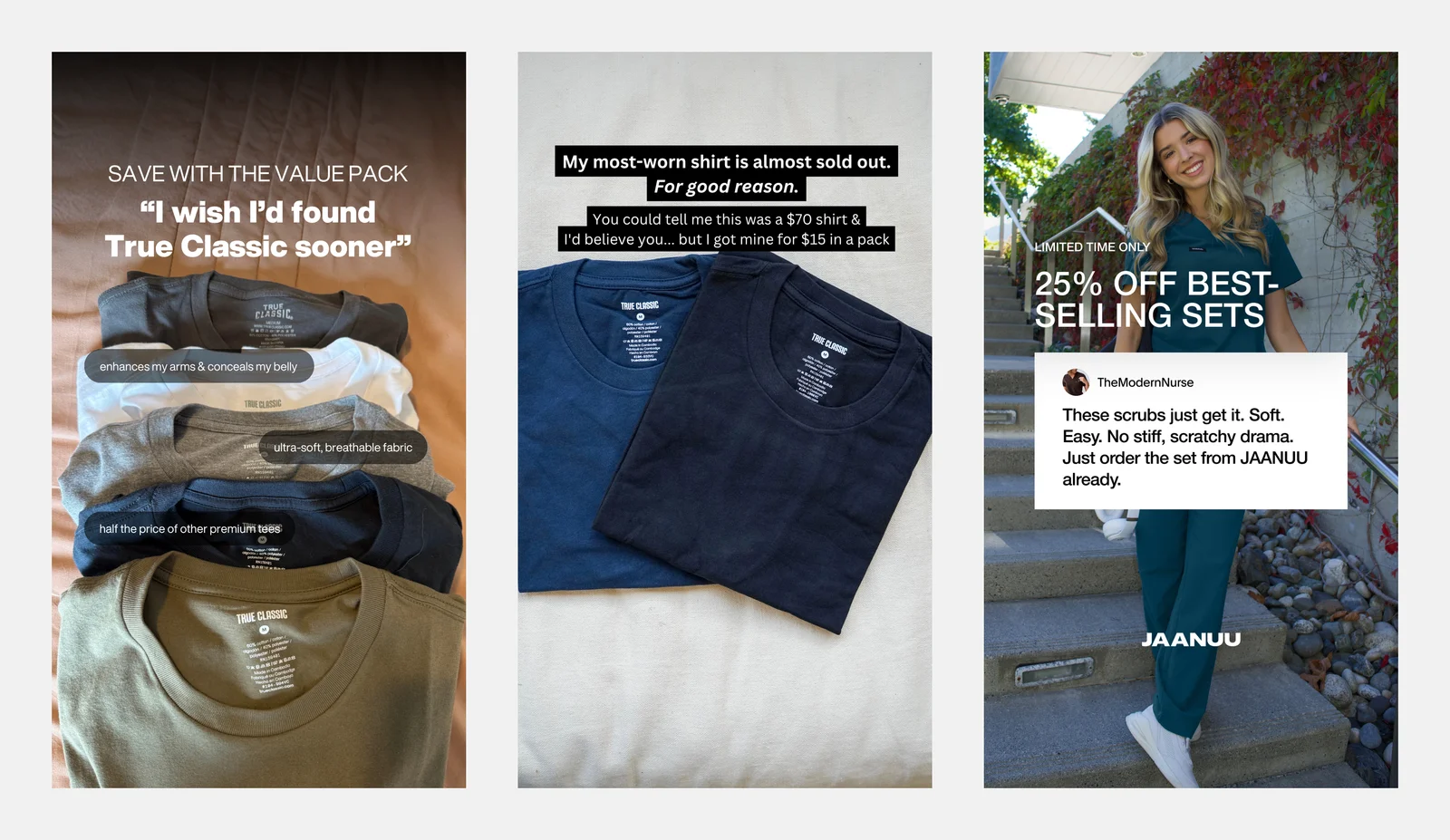
A customer can also say things that would sound wrong coming from you. "Enhances my arms & conceals my belly." "You could tell me this was a $70 shirt & I'd believe you." "Just order the set from JAANUU already." From a brand, that's bragging. From a customer, it's a reason to buy.
What goes in a testimonial ad?
Components of a testimonial ad:
- The quote: what the customer said
- Who said it: a name, stars, a "verified buyer" badge, or a handle
That's it. Who said it proves the quote is real, and it's often where the reader sees themselves. Leave out feature lists, review counts, and extra quotes. Anything that competes with the quote makes the ad weaker.
What makes a testimonial ad work?
A specific quote beats a nice one.
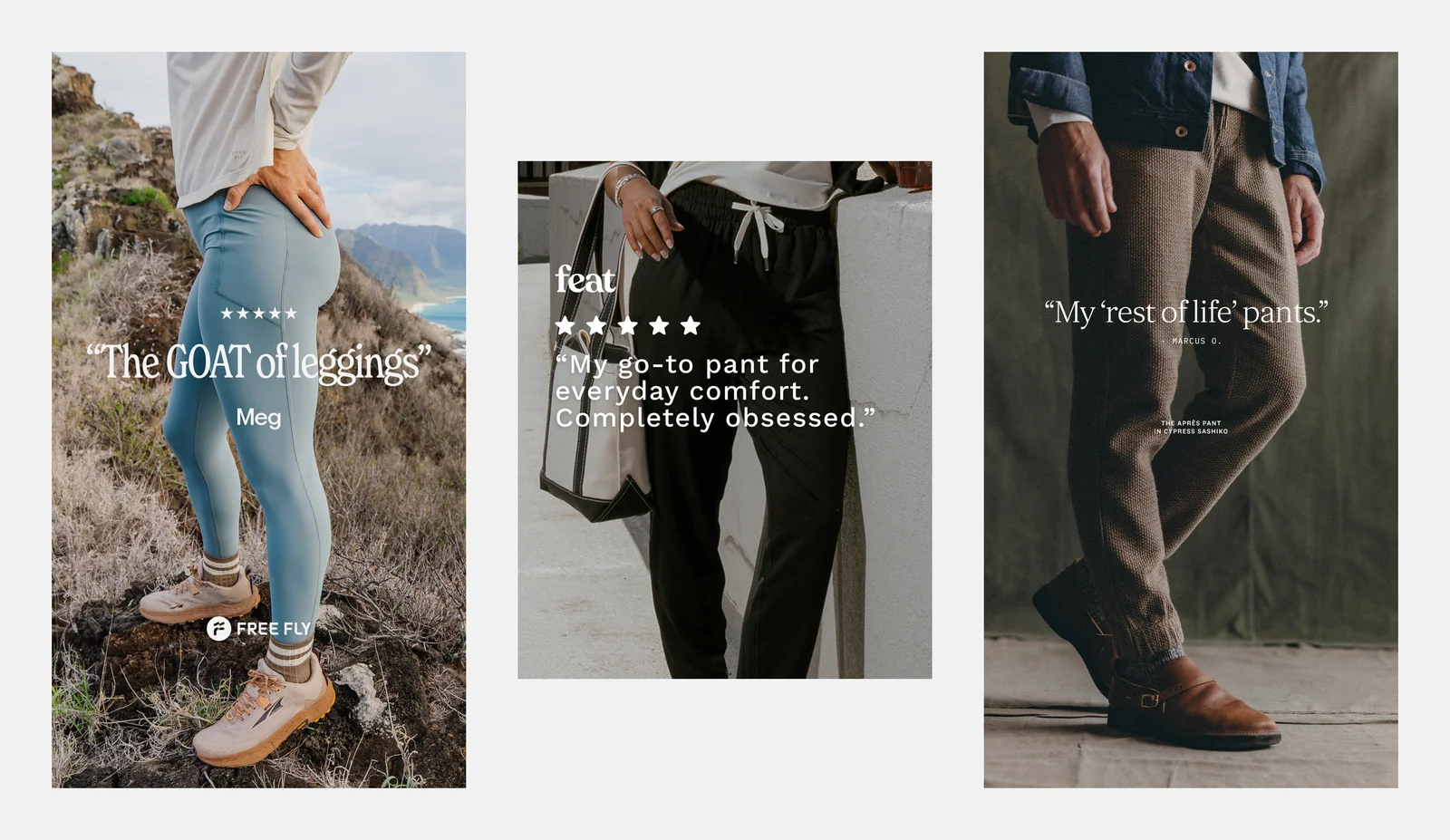
If someone scrolls past in a second, they should think two things: "that's me" and "that's my worry, answered." A nice quote does neither. "The GOAT of leggings." Who is it for? What worry does it answer?
How does the reader know it's someone like them?
The reader has to see themselves in the customer. That can happen in three places:
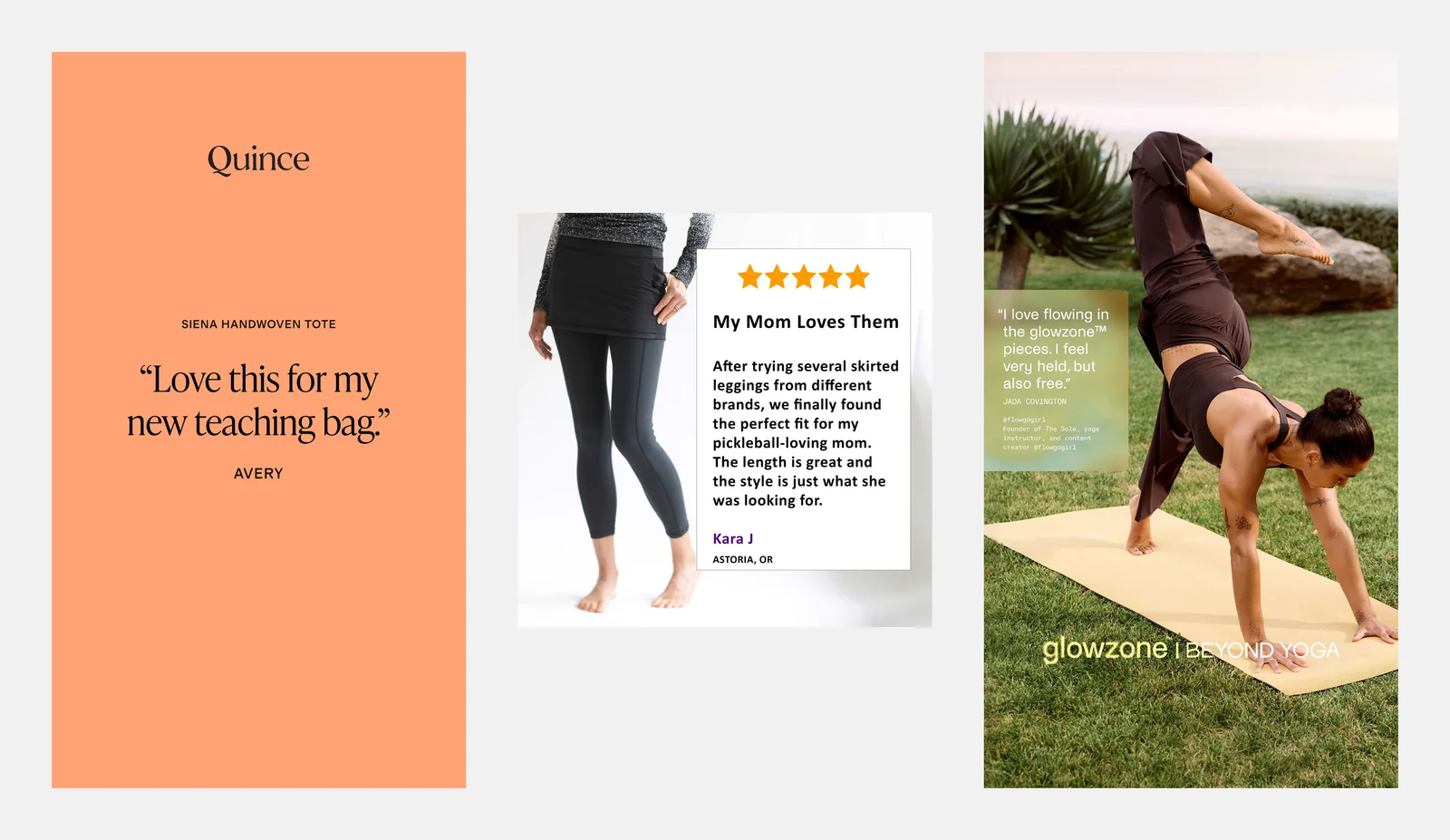
- In the quote: "Love this for my new teaching bag."
- In who said it: "Jada Covington, yoga instructor."
- In the image: a nurse in the scrubs she's talking about.
The best quotes do both jobs at once: they match the persona and answer the objection. "After trying several skirted leggings from different brands, we finally found the perfect fit for my pickleball-loving mom." That's the persona and the objection in one sentence.
How does a testimonial handle an objection?
Pick the quote that answers the worry your reader already has. There are three common ways to do it:
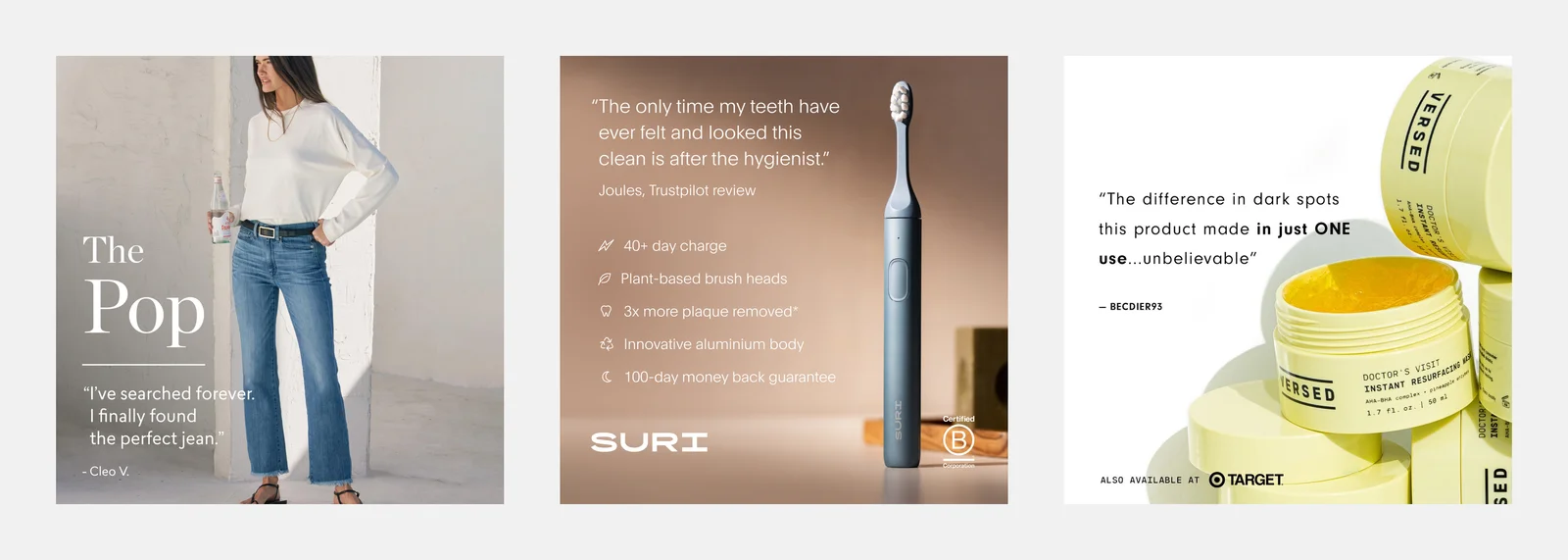
- The search is over: "I've searched forever. I finally found the perfect jean." It speaks to someone other brands have already let down.
- A benchmark: "The only time my teeth have ever felt and looked this clean is after the hygienist."
- Time to result: "The difference in dark spots this product made in just ONE use."
A strong objection is best. A weaker one is still better than none.
What are the three kinds of testimonial ads?
| Kind | What it looks like | Example |
|---|---|---|
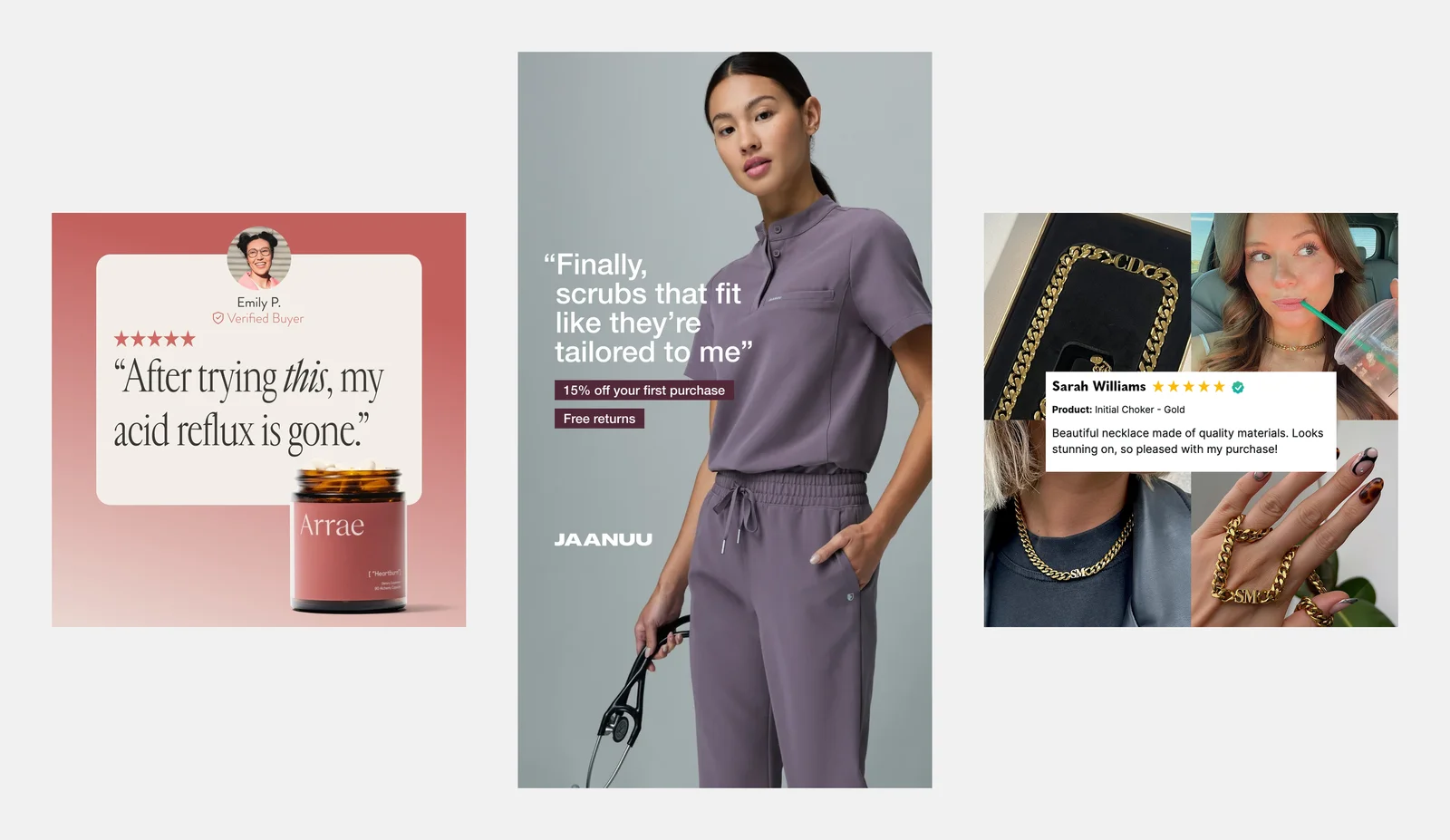
| Review card | It looks like a real review, with stars, a name, and a "verified buyer" badge. | Arrae: "After trying this, my acid reflux is gone." |
| Quote on image | The quote is the headline, over a product or lifestyle photo. | Jaanuu: "Finally, scrubs that fit like they're tailored to me." |
| Customer photo | The customer's own photo next to their words. | Sarah Williams: "Beautiful necklace made of quality materials." |
Native styles, like a tweet or a comment, are a version of the review card. A "review ad" is a testimonial ad in review-card form, and a customer photo testimonial is a kind of UGC ad.
What is the difference between a brand testimonial and a product testimonial?
| Brand testimonial | Product testimonial | |
|---|---|---|
| About | The company, not one product | One specific product |
| Example | "I wish I'd found True Classic sooner." | Comrad: "Extremely well-made and easy to put on!" |
| Sends traffic to | The homepage or a collection | That product's page |

Can a testimonial ad reach a colder audience?
Yes, if the quote leads with the problem. It's rare: only 4 of the 36 testimonial ads in our swipe file reach a Problem Aware audience.
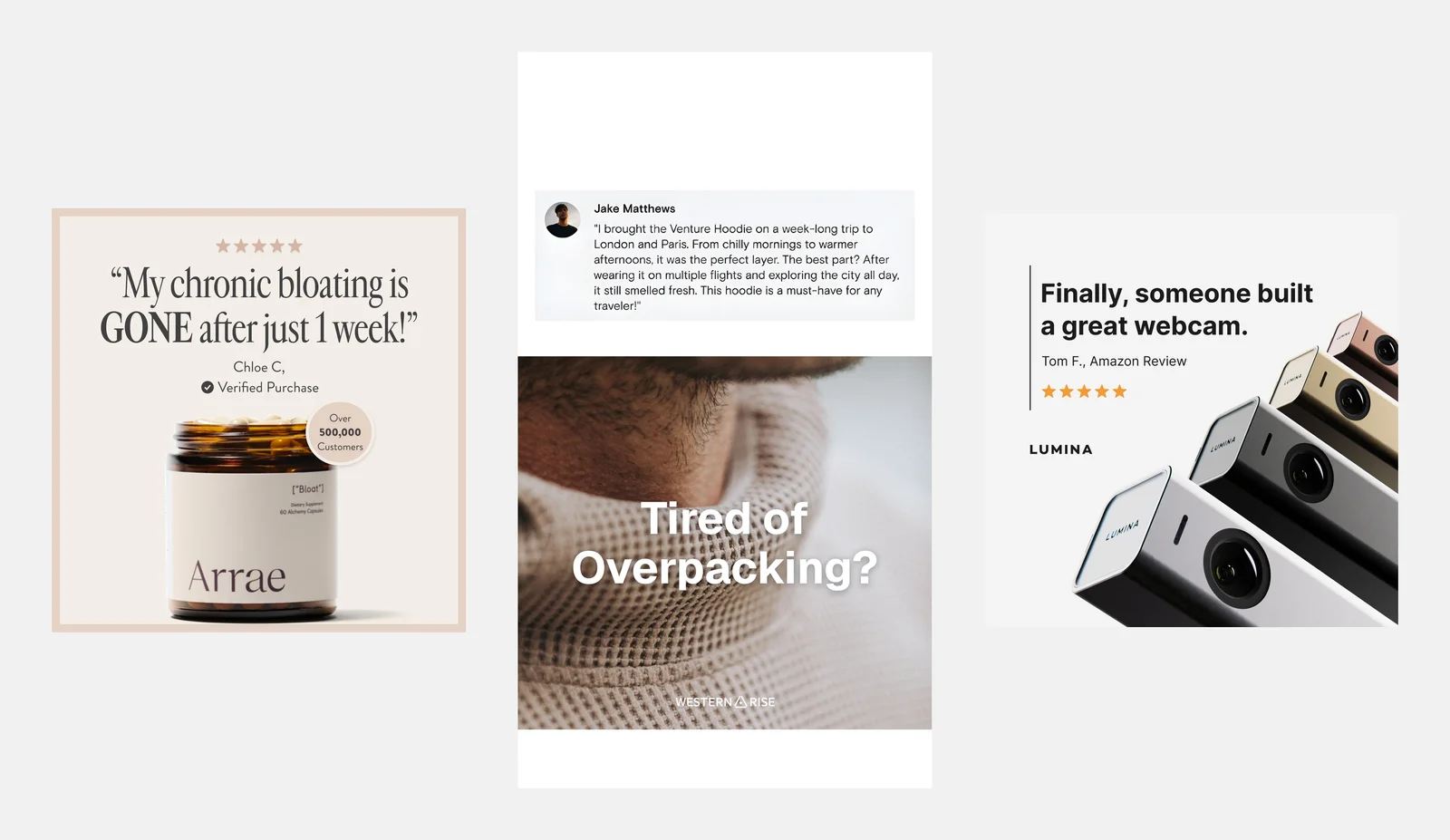
"My chronic bloating is GONE after just 1 week!" works on someone who has never heard of the brand, because they know their bloating. That moves the ad from Product Aware to Problem Aware.
What size should a testimonial ad be on Meta?
Meta image ads come in three sizes:
| Ratio | Pixels | Where it runs |
|---|---|---|
| 1:1 | 1080 × 1080 | Feed |
| 4:5 | 1080 × 1350 | Feed, taking up more of the screen |
| 9:16 | 1080 × 1920 | Stories and Reels |
Of the 35 testimonial ads in our swipe file with a known size, 17 are 1:1, 14 are 9:16, and 4 are 4:5. On 9:16, keep the quote away from the top and bottom of the image, where Meta places the profile name and buttons.
Where do I find quotes for testimonial ads?
Start with the reviews you already have:
- Your review app: Judge.me, Okendo, Yotpo, or Loox on your Shopify store.
- Post-purchase emails and replies: customers often say the best things unprompted.
- DMs and comments: on your own Instagram and Facebook posts.
- Marketplace and review sites: Amazon and Trustpilot. Lumina and Suri both quote reviews from these.
To find the specific ones, search your reviews for the words people use when a worry gets answered: "finally," "I've tried," "after just," "the only."
How do I make a testimonial ad?
- Collect your reviews. Pull them from your review app (Judge.me, Okendo, Yotpo, or Loox), post-purchase emails, DMs, comments, Amazon, and Trustpilot.
- Choose the persona. Decide who the ad is for: a nurse, a yoga instructor, a mom who plays pickleball.
- Name the objection. Write down the worry that persona has before buying: the fit, the price, whether it actually works.
- Find the quote. Search your reviews for one that answers that objection, ideally from someone the persona will see themselves in.
- Choose the kind. A review card, a quote on an image, or a customer photo.
- Keep it to two components. The quote, and who said it. Leave out feature lists, review counts, and extra quotes.
- Size it for the placement. 1:1 or 4:5 for Feed, 9:16 for Stories and Reels.
- Send traffic to the right page. A brand testimonial goes to the homepage or a collection. A product testimonial goes to that product's page.
StaticAds.ai does steps 1 to 7 for you. It reads your Shopify store's reviews, picks the best quotes for each customer persona, and builds the testimonial ads from proven designs, every week if you want.
Frequently asked questions about testimonial ads
What is the difference between a testimonial ad and a UGC ad?
A testimonial ad quotes a real customer about your brand or product. A UGC ad is built from content that customers or creators made, often a video. A customer photo testimonial is both.
What is a review ad on Facebook?
A review ad is a testimonial ad designed to look like a real review: a star rating, the customer's name, and a "verified buyer" badge next to the quote.
Do testimonial ads work on cold audiences?
Testimonial ads work best on a Product Aware audience, people who already know your brand. They can reach a colder, Problem Aware audience when the quote leads with the problem, like "My chronic bloating is GONE after just 1 week!" Only 4 of the 36 testimonial ads in our swipe file do this.
What makes a good testimonial quote for an ad?
A specific quote beats a nice one. In a one-second scroll, the reader should think "that's me" and "that's my worry, answered." "The GOAT of leggings" does neither. "I've searched forever. I finally found the perfect jean." does both.
Should a testimonial ad include more than one review?
No. Use one quote and show who said it. Extra quotes, review counts, and feature lists compete with the quote and make the ad weaker.
Should I put star ratings on a testimonial ad?
Yes, if you have them. Stars, a name, a "verified buyer" badge, or a handle show who said the quote, which proves it's real.
What size should a testimonial ad be for Facebook and Instagram?
Use 1080 × 1080 (1:1) or 1080 × 1350 (4:5) for Feed, and 1080 × 1920 (9:16) for Stories and Reels.
Where should a testimonial ad send traffic?
A brand testimonial, about the company, sends traffic to the homepage or a collection. A product testimonial, about one product, sends traffic to that product's page.
Where can I find more testimonial ad examples?
If you're looking for testimonial ad examples, or need help building them, browse our swipe file.

Get new ads to test every week, automatically.
Our AI comes up with the ideas and builds the ads for your Shopify store, so you always have fresh creative to test.